
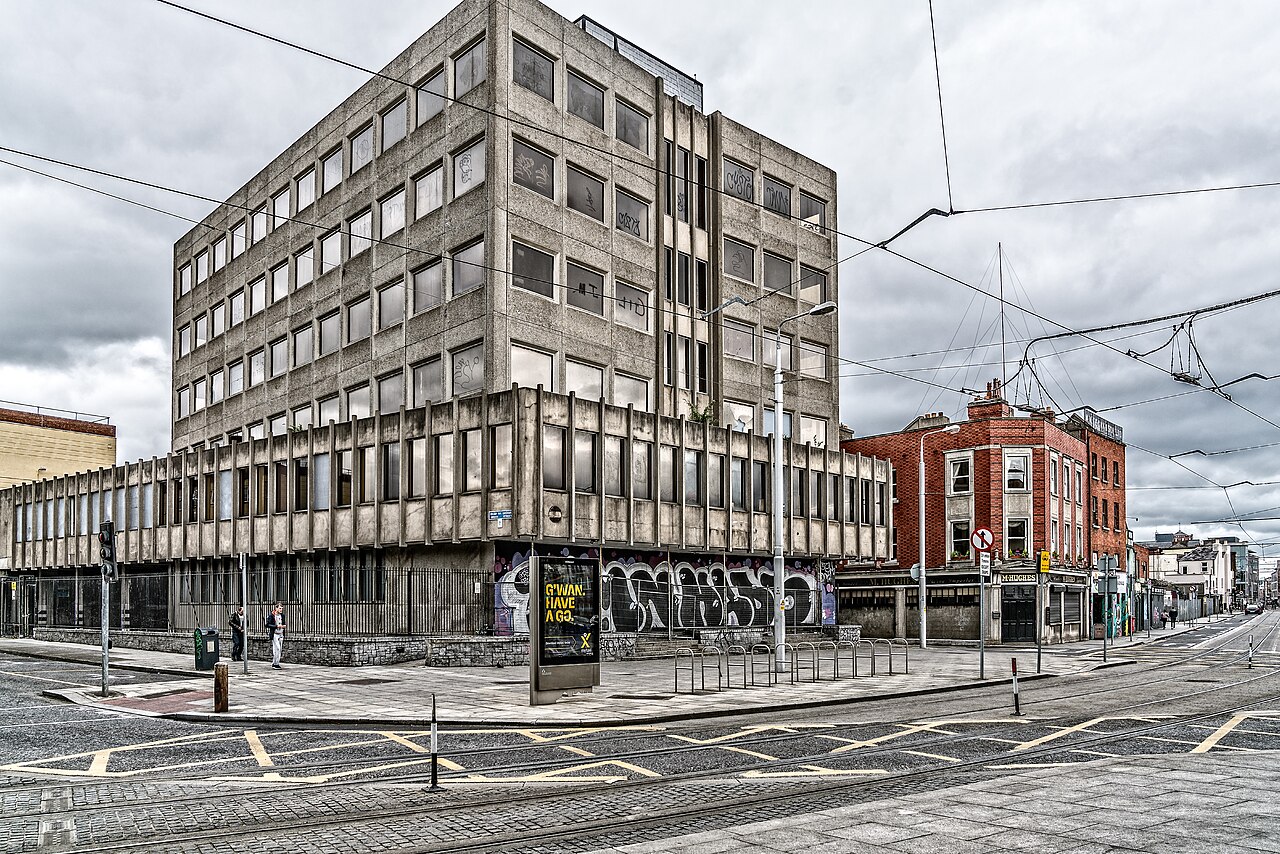
The site of Bull Lane, off Chancery Street (formerly Pill Lane), via Wikipedia. The image dates from a few years back, when the old Motor Tax Office was still in place. Bull Lane comprised the eastern portion of this building, the western portion of Hughes’ Pub next door, and the area behind both.
In the 19th century, a Dublin street called Bull Lane, close to the Four Courts, was notorious for its infamy, to the extent that it was responsible for introducing into the English language the term ‘bully.’ Despite this, little or no reference to this street appears in contemporary publications, something which this post seeks to remedy.
Like other streets in the Parish of St Michan’s, Bull Lane was prosperous in the 17th and 18th centuries but had already started to decline by the time the Four Courts was opened in 1796. Although it was anticipated that the building of the courts would bring back business to the area, the reduction in trade due to the Act of Union and, later, the Famine, accelerated the area’s decline. That said, even against this context, the poverty, infamy, and degradation of Bull Lane significantly exceeded that of other streets nearby.

The first reference to Bull Lane in newspapers is in 1748 when William Beckett placed an advertisement in the Dublin Journal claiming an interest in property there. In 1749 Thomas Hillas, attorney, carried on business in Bull Lane. Thomas’s son Wynne Hillas Esq was to subsequently marry Miss Cherry Black, daughter of the late Counsellor Black and described in their marriage notice as an accomplished young lady with six thousand pounds. This was during Bull Lane’s time of prosperity.
By 1774, Mr. Reynolds’ house at 10 Bull Lane housed Monsieur Praval, professor of the French language, who ran classes for young gentlemen every evening from 5 to 9 in his apartment there, pupils not being allowed to speak anything but French. Monsieur Praval did not stay long in Bull Lane. The following year he advertised himself as having moved to Great Strand Street.
By now, houses in Bull Lane had started to be advertised at low rents, and the lane was getting dangerous. In 1776, a gentleman walking there was attacked by three armed villains; when he resisted, one of them fired a pistol which lightly wounded his left shoulder; they were only able to get his cane. In 1780 it was reported that the box of a poor old woman who let lodgings in Bull Lane had been broken open by two women who lodged with her. One of these women, Elizabeth Callendar, was described as having a remarkable red nose occasioned by scurvy and missing one of her teeth; the other was ‘a fresh-coloured, lusty’ girl of 22 years of age called Elinor Burke.
In 1784, a villain called Thomas Stephens rapped on the door of 15 Bull Lane a little after ten o’clock at night, rushing at the manservant who opened it with a pistol, before being subsequently overpowered. Cords were found on him to tie all the people in the house, and three other villains had been lurking outside. The owner of the house, letting agent Walter Sweetman, who was away at the time, must have been made of strong stuff, as he did not change his residence as a result.
The opening of the Four Courts raised the possibility of better times for Bull Lane. In 1800, houses in the lane were advertised for rent in Saunders’s News-Letter. Noting the contiguity of these houses to the Four Courts and the Linen Hall, the advertisement suggested that they would be suitable for a professional gentleman or tradesman who desired to live at a small rent. In 1803, the Governors of St Michan’s Catholic Church announced that they would lodge fifteen destitute male orphans of the parish in a house in Bull Lane fitted up for the purpose. This did not restore Bull Lane, which began to decline badly. In 1820 fraudulent banknotes were found in the possession of a person ‘of very bad character’ arrested there. Later, the proceeds of a robbery from Ignatius Purcell’s house in Swords were also located in the lane.
The first reported homicide in Bull Lane occurred in 1822, when John Molony died after being thrown down the stairs of 6 Bull Lane by James Birmingham, residing with Mary Anne Kirwan at that address. A news report of the inquest, held in the schoolroom of the nearby Orphan House, described 6 Bull Lane as ‘one of the most infamous of the abominable brothels in the neighborhood of Mary’s Lane.’ Birmingham was convicted of manslaughter.
In 1831, a gentleman visiting Bull Lane was robbed of his watch and seals, a pair of boots and cravat, thirty shillings and some silver. Several bars of iron stolen from John Perry were also found in a cellar there. In 1841 a haul of clothing stolen from a house in North County Dublin was located in Bull Lane by Constable Luke Pinder (148C), described as one of the most active and efficient men in the force. The next year the indefatigable Constable Pinder also discovered in Bull Lane five turkeys, two geese and a couple of hens which had been stolen by residents Catherine Murphy and Bridget Byrne from the premises of Mrs. Walsh at Saggart, County Dublin.
In 1832 it was noted that not only did residents of Bull Lane enjoy no mains water or sewage facilities, but that domestic waste from the surrounding area was in the habit of being dumped in a yard there, affecting the health of its inhabitants. Indeed, the miasma there was so bad that it was regarded as dangerous to pass through the streets. It was at this point that the suggestion was made that a street be opened from the Linen Hall to Ormond Quay, demolishing Bull Lane in the process, but this was never carried through then or later. In 1843 it was reported that houses in the lane were principally occupied by roomkeepers, and advertisements for sale and lease of property in the lane became more desperate, inviting any person interested in laying out money on the premises. Even so, the lane at this point retained some degree of respectability, one newspaper report describing it as ‘let in tenements to poor industrious people.’
Matters became more problematic with the Famine. In 1844 Hugh Gatch, an 11-year-old boy resident in Bull Lane, was charged with wounding another lad named James Atkin grievously in the side with a very sharp knife. Although Atkin filed charges against Gatch before the magistrate, and wanted him punished, he changed his mind when Gatch apologized and promised to conduct himself properly in future – a difficult promise to keep, if you were a teenager living in Bull Lane.
Although the residents of Bull Lane and members of the legal profession pointedly kept their distance, sometimes business overlapped. In 1854, Sergeant Spencer of the Detective Force arrested two residents of Bull Lane in respect of the robbery of the house of the right Hon. John Hatchell, formerly Solicitor-General and Attorney-General. They had broken the glass in his drawing room window at Rathfarnham, and stolen a great quantity of articles including cloaks, coats, boots, and candlesticks.

The tragedies of children enmeshed in the travails of Bull Lane make heartbreaking reading. In 1855 Anne Bradley, described as a woman of ill fame, was brought up before the Capel Street magistrates. Some time since, she had brought from Newry, her native place, a young girl of eleven years, whom she had induced to steal a sum of money from her father. On her arrival in town, Anne brought the girl to a house in Bull Lane where she changed her clothes for inferior garments and pawned the good articles. Anne’s victim may have been lucky – later reports suggest that there was at least one house in Bull Lane in which underage girls were prostituted. The availability of drink in the lane also posed a peril to children. In 1856 an inquest was held at No 9 Bull Lane on the body of a boy of fifteen years of age named William Murphy, one of its residents whose early death was accounted to immoderate indulgence in ardent spirits.
Visitors to the lane – for whatever purpose – were also at risk. In 1857 it was reported that a cattle dealer from Longford named John Tynan, having “arrived a little intoxicated on the night train from the fair of Drogheda”, had “fallen into the hands of a woman of the town.” Under pretence of procuring lodgings for him, she took him to a house of ill fame in Bull Lane where a gang set upon him and divested him of the 227 pounds which he had earned at the fair. He was lucky enough to recover most of this sum.
The parlous condition of Bull Lane may have been contributed to by the fact that it had for some years been owned by James Walsh, a ‘house jobber’ who had a policy of letting on his properties to roomkeepers who, never having a sufficient amount of property to answer a distress, were able to receive rent from lodgers without paying a shilling of rates. The connection between Mr Walsh, known locally as “the Monk” and the residents of Bull Lane was aired in his bankruptcy proceedings of 1861. Another landlord of a houses in the lane during this period was John Hutton.
The landlords may have changed but the robberies continued. In 1862 Mary Ann Keogh and Eliza Blackburne were charged with having stolen five pounds in gold, a riding whip, and a gold breast pin from Mr. William McCuallagh who, while passing through Bull Lane under the influence of drink, had been seized, dragged into a house, and robbed. Meanwhile, Thomas Talbot, living at 1 Bull Lane, was charged with having stolen from the schooner ‘Sarah,’ moored at Sir John Rogerson’s Quay, several articles of wearing apparel and 40lbs of bacon; he was suspected to be the culprit behind several other vessel plunders.
Violence among residents of the lane was also dramatically increasing. In 1858 police on duty at Bull Lane observed Patrick McGlynn behaving in a riotous and disorderly manner while intoxicated. When they sought to arrest him, he took refuge in his own house in the lane, where he proceeded to one of the top rooms and, assisted by members of his family, commenced showering down missiles from a window. One of the missiles hit their mark; Constable 78D suffered a severe and dangerous wound after being struck on the head with a brick. When police sought to force open the door of McGlynn’s house, he ran downstairs armed with a razor, swearing to kill anyone who would attempt to enter. In the end, McGlynn was subdued by a blow on the head and ended up in Richmond Hospital alongside with the constable he had injured.
A sad picture of the lives of the women in the Lane during this period appears in an 1859 report regarding Anne Reilly, charged with having in her possession a pair of new boots for which she was unable to account:
“Though a young person, almost every indication of youth was obliterated. Her watery eyes looked through masses of uncombed, tangled hair that hung about their shoulders like long dry seaweed. Her forehead and cheeks bore divers marks of many an encounter and the absence of some of her front teeth showed that some of her accomplished associates had been practicing dentistry upon her with a poker or some other surgical instrument.”
The following year John Neill traced his 15-year-old daughter Mary, who had absconded, to an infamous house in Bull Lane. To remove her from there, he charged her before the magistrates with having stolen a pair of gloves and shawl belonging to his wife. In 1861 Michael Burton was charged with having brutally assaulted his wife Mary Burton in Bull Lane. He had first knocked her down and then taken off one of his heavy boots and beat her with it.
In 1866 Private Mortimer Ryan of the 8th Regiment was brought up on remand, charged with having committed a violent assault on a deaf and dumb woman named Anne Dogherty in a house in Bull Lane. He had struck her repeatedly with his belt buckle, inflicting several severe wounds; she was still in hospital. In 1868, John Lucas was indicted for feloniously assaulting a young woman named Mary Anne Reilly with a pitchfork and throwing her out the window.
In March 1870, Michael Killeen was charged with assaulting a girl named Brown by striking her in the eye with a loaded whip and, when she fell, beating her on the head and arms. Remanding him, the presiding magistrate, Mr O’Donel, remarked that since he came on the bench his feelings had never been so outraged by any case.
The second reported homicide associated with Bull Lane occurred on the 7th of February 1866, when Charles O’Neill, otherwise known as Constable 49D, was assassinated when going his rounds at a quarter past twelve in the morning. While heading towards the Lane after hearing a woman there cry out ‘Police,’ a shot from a revolver entered his abdomen. Immediately after, a second shot was fired which penetrated O’Neill’s stomach. He continued walking for some time after, and the course he took could be traced by his blood. Richard Kearney, a blacksmith, was subsequently convicted of O’Neill’s murder. After this death, constables patrolled the lane in pairs only, armed with revolvers.
In 1870, Bull Lane was the scene of “one of the most fearful and deliberate murders that had taken place in Dublin.” The deceased was 26-year-old Margaret Murphy, a prostitute originally from the country, who had lived in Bull Lane for 7 years. Her murderer was her lover, Andrew Carr, “a tall muscular man, rather well looking, with dark hair and eyes,” recently been discharged as a pensioner from the 87th regiment.
A poignant description was given of Margaret’s corpse, lying on the floor of her room, with long brown hair protruding between a gipsy straw hat with blue ribbon and artificial flowers and white tress trimmed with blue. The Carlow Post described the house in which she was found as “once a well-built old-fashioned house built a century ago when Bull Lane was inhabited by respectable citizens. By the time of the crime, every window had been smashed or the shades entirely removed. The banister was wrenched off, and large portions of the old greasy paneled woodwork of which the walls of the staircase were composed of were removed.”
At Carr’s subsequent trial for murder, Bridget Bryan, of 9 Bull Lane, gave evidence that he and Margaret had lived together in her house some years ago, when he was home on leave, before Margaret was admitted to the Lock Hospital to be treated for venereal disease. Shortly thereafter, Carr, who may also have been infected, informed Bridget that he would “have his revenge on Margaret by land or sea.” After he left the army, he went back to living with Margaret, and, it seems, carried out this revenge by cutting her throat so that her head was almost severed from her body. Carr was convicted and hanged.

While Margaret’s remains still lay on the floor of her house in Bull Lane, another woman was fighting for her life in the hall of another house nearby. Hanna/Honor Fogarty was admitted to the Richmond Hospital after being attacked in the hall of 8 Bull Lane from three other women: Bessie McCloskie, Mary Stewart, and Bessie’s 14-year-old daughter Mary. She subsequently died from inflammation of the lungs induced by the beating given to her.
In 1870 an order was made against landlords Thomas Doyle, John Keogh, James Flanagan, and Thomas Molloy that the houses 5, 7, 8 and 11 Bull Lane be closed due to their uninhabitable condition. Prosecutions against occupants of the lane for selling drinks without a licence also began to increase, but so did the horrors.
In 1871, Eliza Healy, a prostitute from Bull Lane walking on the banks of the Royal Canal, drowned after being hurled into the Canal by a blast of great force. Eliza’s son, aged six, was subsequently the subject of a welfare application by Inspector James Flower of the D Division, in which the boy pleaded to ‘go home’ to the Lane – a request which was not granted.
In 1873, after three women named Dunne, O’Neill and Thompson, all residents of Bull Lane, were charged with robbing a car-driver named Connell, it was recommended that carmen should not drive into Bull Lane.
In 1874 Edward Conway attempted to cut the throat of Rose Flynn in Bull Lane, in July 1875, William Kearney wrenched a leg off a table in a house there and struck Mary Williams with it, and in October it took six constables to subdue a young man named Charles Lucas, a resident of Bull Lane and arrested for being drunk & disorderly.
Also in 1875, James Byrne, “one of those characters known as bullies,” was charged with having assaulted and stolen money from John McLoughlin, whom he had taken into Bull Lane under pretence of obtaining him employment in Roe’s Distillery. The same month, when military police officer Albert Hutchinson went down to Bull Lane to search for prisoners absent from roll call, he was hit across the head by Thomas Blakely and Mary Collins.
In May 1876 there was a minor scandal when it was discovered that a prostitute from Bull Lane named Anne Dalton had visited the Curragh Camp with her baby and John Donahoe, also of Bull Lane, and dined with the militia in camp, the soldiers, serjeants and officers knowing her character. The above caused Mr Bettagh, the magistrate, to remark that it was certainly a singular state of things at the Curragh.

In June 1876 Catherine Kirwan from Bull Lane, aged twenty, climbed onto the wall at Church Street bridge between 12 and 1 am in the morning, saying to an unidentified person standing near her ‘Shake hands with me before I go.’ Boats and drags were procured, and a buoy thrown at her, but she made no attempt to catch it. It was initially rumoured that there had been a soldier in her company, who when she threw herself over the wall immediately jumped after her and was himself drowned, but this story was later discounted. Catherine had lived all her life in Bull Lane, where her mother had been a brothel keeper. She had originally made her living by selling porter and now lived off the charity of prostitutes after having spent much of her time in prison for attempting suicide and assaulting the police.
In September 1876, a woman named Julie Dunne died in Bull Lane after having been severely kicked, and Mary Hopkins was charged with attempting to kill and murder her son aged six, by putting him out the window of a house there. The possibility of demolishing Bull Lane during erection of a new street from the rear of the Four Courts was once again mooted.
More tragic stories kept coming to light. Theobald Brophy, “a man of quiet and respectable appearance,” appeared in the Dublin Police Court to charge his 13-year-old runaway daughter Marie, discovered in a house of bad character in Bull Lane, with stealing. Brophy told the court about what he had discovered looking for Maria, saying that no one, either the magistrate or the priest, had the slightest idea of the level of child degradation carried on in the city – up to ten little girls harboured in a single house in a disreputable locality by apparently respectable women, with anyone who sought to interfere charged with assault.
Meanwhile, 13-year-old William Murray, the son of a brothel keeper in Bull Lane, was charged with an assault on Bridget Mitchell, ‘a pale pretty looking little girl,’ who ran messages for the owners of another brothel in the lane. Bridget had been running through Chancery Place when William knocked her down and kicked her in stomach, so that she was unable to move in agony. Mrs. Murray, who entered the witness box with her son, said he was ‘as good and as nice a boy as ever stepped when not under the influence,’ and that it ‘did not often happen that he was overcome by liquor.’ It was noted that the children had no knowledge of either God or catechism.
By this time, orders had been made to close 4, 5, 8, 9, 10, 11 and 13 Bull Lane as unfit for habitation and fines began to be levied against landlords, such as Mary Keogh, who failed to comply with these orders.
The final straw came in 1878, when John McClure killed his mother Ellen by throwing her out of the window of 3 Bull Lane after fight regarding money, and Charlotte Lodge of 11 Bull Lane died after a horrific rape and beating by several men resident in the Lane. Charlotte appears to have been a woman of spirit – when thrown into the Canal by a soldier the previous year, who told her it was ‘a good night for a swim and a wash,’ she had reported him to the police.
Charlotte had recently been released from prison. Maybe there was a suspicion that she was a police informant, or perhaps her unquenchable spirit simply posed a threat to the ‘bullies’ in the Lane. Charlotte’s attackers were subsequently acquitted of her murder after an extremely favourable summing up by the newly appointed Lord Chief Justice of Ireland George Augustus Chichester May. Strangely, a woman witness to the attack also died the same day on which she was due to give evidence at the trial.

In November 1878 a letter to the Freeman’s Journal suggested that the best course of action would be to erect a Metropolitan Cathedral on the site of Bull Lane as the sanctifying influences of consecration would remove the atmosphere of prostitution, “saintly aspirations from virgin lips” atoning for the crime of their fallen sisters.
Another letter to the same publication was more sympathetic to the women of Bull Lane, suggesting that they deserved charity:
“Some of them – most of them, in fact – have been seduced in the country, and fly from their friends to Dublin to hide their own shame and screen their relatives from the bad word which is sure to attach itself to anyone belonging to the fallen in an Irish country village. They come to the metropolis, but here they find now home… they become after a few days; hunger the dupes of the procuress and others of that class, who soon introduce them to the brothel. Then all is lost, and in a few short miserable years the grave has its victim. But the worst classes of unfortunates in Dublin, strange to say, are those who have been married, and through the desertion of their husbands or from bickering at home, are cast on the streets. If they have children, they bring them to those dens and rear them up in the life they have chosen for themselves. The boys become thieves, eventually bullies, and the girls the most worst and degraded prostitutes.”
The same month it was published that in addition to two hundred prostitutes residing in the Bull Lane, there were a further sixty or seventy men who “live upon the women and torture them in the cruelest way, fattening on the plunder of dealers who come up to the country for Thursday’s markets.” It was with these men that the name ‘bullies’ originated.
In response to queries as to why Bull Lane had not been compulsorily acquired by the Corporation, it was suggested that this was because such acquisition would have had to include several licensed houses, entitled to large sums in compensation. Orders continued to be made against landlords of houses in the lane for not keeping their property in habitable condition, and these now included orders for demolition.
On 1 March 1879, the Freeman’s Journal was able to report that:
“During the past few months, quietly and unknown to the general public, a work has been in progress in Dublin calculated to materially benefit the city. By a judicious use of the authority vested in them and a rigid exercise of their legal powers, the police have succeeded in thoroughly cleansing that den of infamy, a disgrace known as Bull-Lane.
The existence of this moral plague spot has been for very many years a shame to civilisation and a disgrace to Dublin. The alarming increase in the number of robberies, thefts and minor offences committed by the male and female denizens of Bull-Lane, and in addition the number of violations of the law concealed by them, impressed the police authorities with the absolute necessity of thoroughly clearing the place of its criminal inhabitants, and after two months’ hard work they have succeeded in doing so, and at the present moment any one may walk from end to end of Bull-Lane without in any way being molested or insulted. It would rather remind one at the present time of a street in the city of the dead, for all the houses of ill-fame, which numbered nearly twenty, have been closed up and are now untenanted.
This moral campaign has been carried on under the direction of Superintendent Devin, and has been conducted on the simple principle of, to speak plainly, making the place too hot to hold its animal population. Two policemen, relieved at stated periods, were placed on duty at the end of the lane, and a close watch kept on everyone entering and leaving it. By this process the police were enabled to detect an immense number of breaches of the Licensing Acts, for the illicit drink trade was carried on here with greater briskness. Each week convictions were obtained against the proprietors and frequenters of the houses of infamy, and they were sent to prison for terms extending from a week to two months. Meanwhile every stranger who attempted to go up or down the lane was stopped and questioned by the police, informed of the nature of the locality, and warned that if he had money or valuables of any kind on his person, he ran a considerable risk of being robbed. Almost in every case this had the effect of turning such persons back and of preventing others from going near the place.
The result was that the unfortunate girls who dwelt in the lane were compelled to fly from it, and each day saw several of them, together with such wretched property as they possessed, take to flight. It is pleasing to state that very many went to charitable institutions in the city to atone their former errors by repentance and amendment. One of the most important features in the entire work has been the breaking up of the community of idle ruffians called ‘bullies’ of whom there were no less than seventy-six in the lane, living by robbery and the proceeds of infamy of the unfortunate women. Some idea of the magnitude of the work effected may be formed when we state that the police counted 207 unfortunates living in the locality, and as many were in various parts of the city at the time the census was made, the number may fairly be increased by 150. Thus is Dublin rid, let us hope for ever, of an abode of crime unsurpassed by any similar spot in the cities of the kingdom.’ “
In a final, tragic coda, for some years thereafter former residents of Bull Lane continued to congregate in the locality of their former home. In August 1885, Bridget and Mary Murphy were charged with wandering abroad having no fixed residence, and living in the open air at Bull Lane, being two of several women who were in the habit of loitering and cooking their food gipsy fashion at fires which endangered property in the neighborhood. They were sentenced to imprisonment. The erection of the new Vegetable and Fish Market nearby seems to have put an end to this practice.
In the second half of the twentieth century, the site of Bull Lane was home to the Motor Tax Office, now replaced by a hotel. Any given weekday morning now, it is possible for visitors to the Four Courts to sit and drink a coffee at the former entrance to the Lane and admire the pleasant view along Chancery Place up to Christchurch Cathedral.
It is an ending worthy of Wuthering Heights – were it not for the horrors preserved for posterity in the newspaper reports recounted above, it would be difficult to believe that any unpleasant scenes could ever have unfolded in such a quiet and peaceful spot in the shadows of one of the world’s most beautiful temples of justice.
But so, lest we forget, they did.
This post is in memory of all those who lived, and suffered, within the precincts of Bull Lane during its time of infamy.

Leave a Reply