
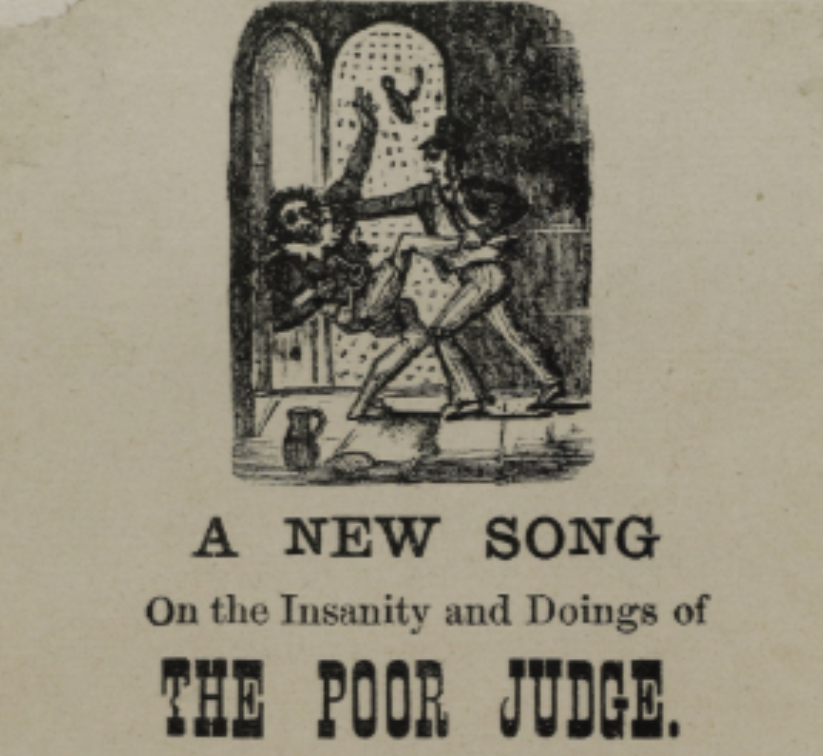
The ‘Poor Judge’ of the following ballad is none other than William Nicholas Keogh, Judge of the Court of Common Pleas in Ireland, 1856-78.

Lest they cannot be read from the above image, the lyrics of the ballad are as follows:
“Oh! There’s another good man gone wrong, burreo hurreo
Who is well known to you, it’s true, it’s true;
After the life which he had spent
It’s time that he should now repent
To do everything he was always bent
Oh! Cromwell we hardly knew you.
CHORUS
With your gown and wig, your wig and gown
Your enemies they well know you
Both young and old as now I’m told
Say judge we hardly know you
After all the deeds that you have done, hurroo, hurroo
We’re afraid your glass is nearly run, hurroo, hurroo
For it’s well know this many a year
By young and old both far and near
You were always a rogue as we do know
Judge dear we hardly know you
You can’t deny but this is true, hurroo, hurroo
Your Valet you did nearly slew, hurroo, hurroo
You thought to take his life away;
When he was going to ready your tea
If he had to die you’d surely pay
The rope would surely crook you.
Oh! Where’s your senses gone at all, hurroo, hurroo
It’s often asked by great and small, hurroo, hurroo
What will we do when you will die
For you I’m sure we all shall cry
Many thousands they will say good-bye
Poor judge no more we’ll see you.
Oh! Mr judge you know you’re bad, hurroo, hurroo
At your misfortune we’re all glad, hurroo, hurroo
In your doings we never took delight
For you never done what was said to be right
You’d surely say that black was white
Judge we hardly know you.
18 years ago we don’t forget, ’tis true, ’tis true
Two brothers you condemned to death ’tis true, ’tis true
In Nenagh town ’twas and to see
Them die upon the gallows tree
You forced their guilt by the jury
Judge it’s well you know that.
To tell you more of what you know ’tis true, ’tis true
About Galway City six years ago, ’tis true, ’tis true
When Captain Nolan he had been
Tried by you, ’twas plainly seen
By your false heart our priests and him
‘Twas there you did rebuke them.
So now ’tis time to end my song to you, which is true
I hoped have said nothing wrong, to you, to you,
For everyone knows as well as can
That judge is a great enemy
With all I told you I hope you will agree
And say, Judge we hardly knew you.”
Keogh, who presided over many politically charged cases, was the subject of many unflattering ballads during his judicial career. Once, while walking to the Four Courts, he heard one of them being sung; he gave the singer a few coins regardless.
The woodcut at the start of the ballad depicts a razor attack allegedly carried out by Keogh on his valet – actually Keogh’s long-standing tipstaff, carrying out ex officio duties – in a German spa town in 1878. The valet survived; but Keogh died some weeks later; accounts of what exactly happened are still disputed by his descendants.
Biography and image of Judge Keogh here.

Leave a Reply