
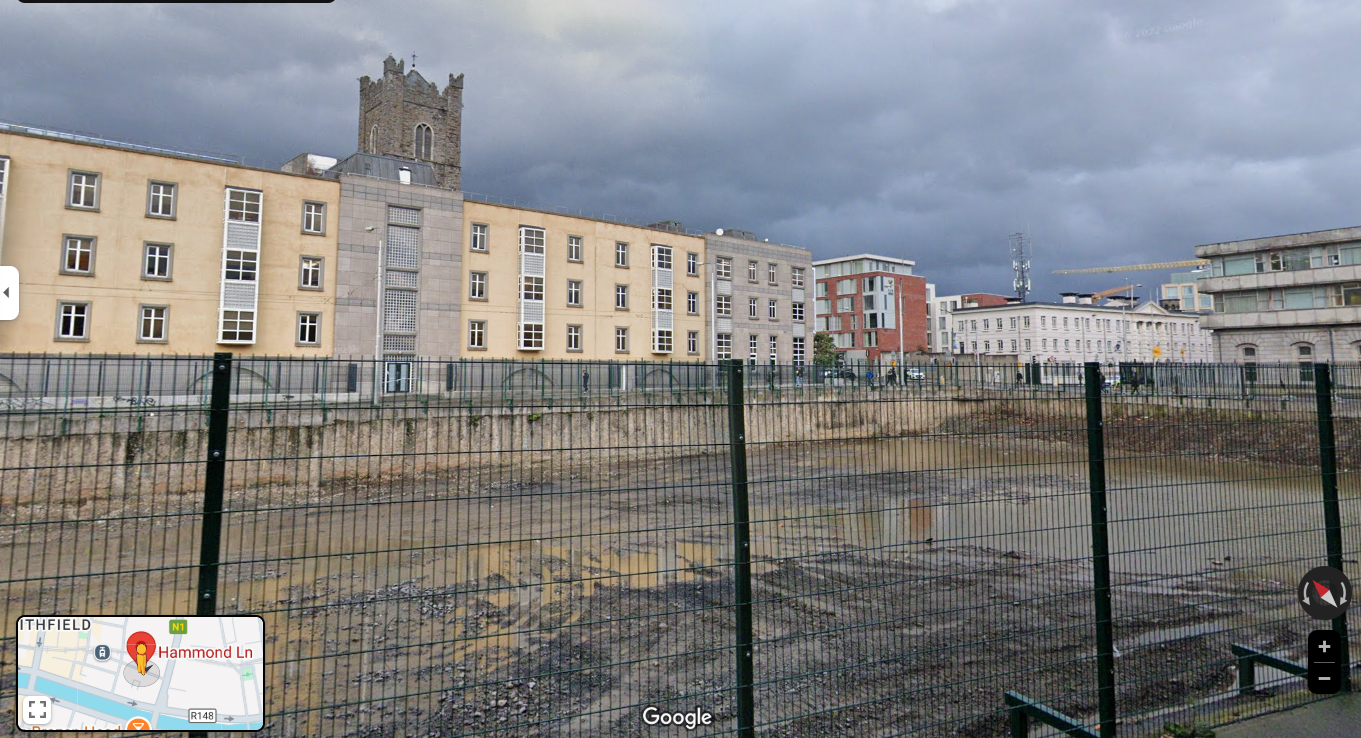

In this post we travel back in time to look at the 19th century history of the site 167-169 Church Street, Dublin, the intended site of the new Family Law Courts.
Back in the glory days of Smithfield, this site formed part of the townhouse and gardens of the General Surveyor of Excise Patrick Aylmer, but by the early 19th century this had been replaced by three less imposing buildings.
As the numbers of the houses in Church Street provokingly run downwards to the Liffey, we will start with the house closest to the river – 169 Church Street, situated at the corner of Church Street and Hammond Lane, just across the road from the western side of the Four Courts.
There was, as shown on the plan below, for many years a public house there run by the O’Reilly family. They were there as far back as 1836 when a jet-black mare, five years old, 14 hands high, free from vice and drawing quietly, was advertised for sale at Martin Reilly’s,169 Church Street. Mr Reilly subsequently died, and the premises were taken over by his widow Julia, described as a sober, steady, collected and remarkably well conducted woman.
Of delicate health, Julia frequently complained of a pain in her chest. In 1851, she was joking and speaking at the bar when she suffered what seems to have been a heart attack. Water was brought to her, but she never revived and was dead before the doctor’s arrival. Anne Killen, servant, stated that the previous night Julia had been a state of much excitement; a young woman came down to borrow 10 pounds and this fretted her much. Julia was a widow without children, so perhaps this young woman was a niece or a friend.

Some years later, in 1867, Patrick Winter placed an advertisement in the Advertising Gazette to inform his friends and the public that he had opened a wholesale and retail tea wind and spirit establishment at 169 Church Street, offering a large and choice selection of teas, sugar, whiskey, wines and brandies at the lowest possible price. Unfortunately, in October 1868, Mr Winter was brought up under a writ of habeas corpus charged with having forged a bill of exchange, purportedly from his father-in-law, who denied any knowledge of the bill
169 Church Street was were still licensed in 1888, and under the proprietorship of Mr Mordant, when a mysterious shooting affray took place there. A man named Samuel Richardson, compositor, drew a pistol from his pocket and fired a shot into a party of workers from nearby Jameson Distillery drinking there; fortunately, it only grazed one of the intended victims.
It seems that the license had lapsed on 169 Church Steet by the time it was advertised for sale in 1892, when the Dublin Daily Express described it as a very large shop with double frontage at the corner of Hammond Lane, fitted with counters, shelving and excellent cellar and sanitary arrangements, and, significantly, apartments above, the gross income from which was £1 8s 6d weekly.
This reflected the stark reality that, with the influx of homeless country folk after the Famine, Church Street was fast becoming a district of overcrowded lodging houses. In 1897, an inquest was held at 169 after one of its inhabitants, Michael Purcell, was found dead in his bed. It transpired that there were only four beds in the room in question, occupied by 7 men. Mr Purcell, described as an ‘old man’ at 58, was lucky to have a bed to himself.
At the inquest, the City Coroner strongly condemned the system of overcrowding in the lodging houses of the city and invited an expression of opinion from the jury on the subject. Nine of the thirteen jurors were in favour of adding a rider condemning the system of overcrowding in lodging houses, but four were against, one of them saying that it was all very well condemning overcrowding in lodging houses, but poor men needed somewhere to live.

The neighbouring premises in 168 Church Street seems to have been solely a lodging house. Across the road from it was the entrance into Pill Lane (now Chancery Street), which was originally very narrow. On the night of 18th October 1838, a dray passing through this entrance collided with a side wall, jamming up three persons just passing. One of them was a fine youth of about sixteen years of age by the name of McDowell, who lodged at 168 Church Street with his mother, a widow; his eye and cheek were torn away in the accident.
Many of the female incomers to Church Street after the Famine fell into prostitution to support themselves and 168 Church Street must have been an attractive location for this line of work due to its proximity to the nearby barracks. In December 1859 Luke Flynn, a private soldier belonging to the first battalion of the 69th Rifles, was stabbed in the breast in the hall of 168 and taken to the Richmond Hospital; Patrick McKenna, labourer, was subsequently charged as a result.
Private Flynn may have sustained his wounds when visiting Margaret Brian, 168 Church Street, who was charged in March 1866 with stealing from a room in the Royal Barracks two forage caps, with cold bands and buttons, the property of Sergeant Scott, 5th Dragoon Guards and Sergeant Hall, of the same regiment. Although Sergeants Scott and Hall discreetly described Margaret as “a dealer [who] was in the habit of frequenting the barracks in pursuant of her business” it appears that the business that she was in was that of negotiable affection rather than old clothes. Margaret and her sister Kate were later charged with indecent conduct in the Phoenix Park on 24 July 1868 and ordered to find bail of one householder in £10 or be imprisoned for 14 days each.
By 1876, James Kenny, owner of 168 Church Street was fined 40s for breach of an order to close it as unfit for human habitation. A few years later, 167 and 168 Church street together with their building materials, were advertised for lease, with a requirement that the tenant rebuild at an outlay of £600. The Irish Times of October 1885 reported the subsequent letting of these premises to Mr Hammond of the nearby Hammond Lane Foundry.
Mr Hammond must have rebuilt, since by 1911 168 Church Street was a lodging house again. The Evening Irish Times of 10 February of that year records a summons against its owner Jeremiah Fogarty, who had been found with a barrel of porter on tap in his kitchen, without any licence. Mr Drennan, solicitor for Mr Fogarty said it had been a practice for generations for porter to be dispensed to customers in eating houses, and more recently the further practice had developed of Church Street lodging-house keepers also bringing in friends for some porter. The Magistrate, Mr McInerney KC, said that he was satisfied that Mr Fogarty did not keep the porter for the purposes of selling it and dismissed the case.
167 was also a lodging house, and in 1863 a fire broke out there when an old woman in the back cellar set some shavings ablaze by accident when kindling her fire. The No 1 Corporation engine arrived within five minutes and dealt with things promptly.
A new lease of 167 with a covenant to rebuild was granted to Mr Luke Doyle in 1882, possibly not a moment too soon, since, in December of that year, several returned convicts were charged with having been concealed there between three and four o’clock on Christmas morning, with intent to commit a felony. They were convicted as vagrants and rogues and sent to jail for two months each with hard labour.
In 1895, another returned convict was charged with stealing corn sacks from outside the door of 167. When Mr Cullen, the owner of the sacks, sought to effect a citizen’s arrest, the convict assaulted him with an iron implement, leaving him on the sick list.
It is understandable that after these events the police were keeping a careful eye on 167 Church Street. This backfired some years later when a constable, passing the house in August 1900, heard a noise and noticed that the door was partially opened. On pushing the door, he was struck and knocked down by the owner of the house, Patrick Dowling, who had taken him for a burglar. Dowling subsequently resisted arrest and was sent to jail for two months.
There is little published about 167-169 Church Street after 1900 or so. At some stage prior to the end of the 20th century, the houses on the site erected under the 19th century covenants to build were demolished. In 1999, a compulsory acquisition order made in respect of 169 as a derelict site included the open plot of ground on which 167-8 Church Street had formerly stood.
Although many houses in Church Street were the scene of spousal disputes over the years, sometimes of the most violent kind, we find no reference to any unhappy marriages in 167-169.
We can only hope that the spirit of marital peace which seems to have prevailed there will carry over into the new Family Law Courts!

Leave a Reply